The Ontime Ontology

Release: "15 April, 2026"
- Modified on: "15 April, 2026"
- This version:
- https://w3id.org/ontime#
- Previous version:
- https://w3id.org/ontime#
- Revision:
- v1.0.0
- Issued on:
- Date issued
- Authors:
- Jyrki Oraskari, Chair of Individualized Production, RWTH Aachen University
- Jan Luca Fahrendholz-Heiermann, Chair of Individualized Production, RWTH Aachen University
- Contributors:
- Jyrki Oraskari
- Jan Luca Fahrendholz-Heiermann
- Sigrid Brell-Cokcan
- Publisher:
- RWTH Aachen University
- Imported Ontologies:
- none
- Extended Ontologies:
- none
- Funder:
- The Federal Ministry of Transport (BMV)
- Funding:
- funding number 01F1219A
- Download serialization:


- License:


- Visualization:

- Cite as:
- Oraskari, J., Fahrendholz-Heiermann, J. L., & Brell-Cokcan, S. (2026). The Ontime Ontology (Version 1.0.1). Chair of Individualized Production, RWTH Aachen University. https://w3id.org/ontime#
- Incompatible with:
- ""
Abstract
The Ontology for Open Mobility Data provides a structured framework to link external mobility datasets with Just-in-Time (JIT) construction logistics concepts. Its goal is to achieve semantic alignment between diverse open mobility sources and lean construction needs. Rather than modeling internal construction processes, it maps external data—such as traffic, transport, and mobility information—to relevant JIT concepts. By defining shared semantics, the ontology enables interoperability and data reuse. It is built on a manually curated baseline and refined using large language model (LLM) embeddings to cluster domain terms, define scope, identify datasets, and suggest reusable components.Introduction back to ToC
The Ontology for Open Mobility Data offers a structured semantic framework for representing external mobility datasets and connecting them to Just-in-Time (JIT) construction logistics concepts. Its main goal is to facilitate semantic alignment between diverse open mobility data sources and the internal logistics needs of lean construction workflows. Instead of modeling the internal construction domain itself, the ontology concentrates on mapping external data sources—such as traffic, transport, and mobility information—to relevant JIT logistics concepts. By establishing shared semantics, it promotes data interoperability and reuse, enabling construction stakeholders to incorporate real-time mobility information into operational decision-making. This approach is especially useful in scenarios where route restrictions, traffic conditions, and external events impact construction logistics. The ontology is built from a manually curated baseline and enhanced through large language model (LLM) embeddings. These embeddings help cluster domain terms, analyze scope, identify relevant datasets, and suggest reusable ontology components. This hybrid method combines expert-driven structure with AI-supported scalability.Namespace declarations
| dc | <http://purl.org/dc/elements/1.1/> |
| km4city | <http://www.disit.org/km4city/schema#> |
| mod | <https://w3id.org/mod#> |
| ontime | <https://w3id.org/ontime#> |
| owl | <http://www.w3.org/2002/07/owl#> |
| rdf | <http://www.w3.org/1999/02/22-rdf-syntax-ns#> |
| rdfs | <http://www.w3.org/2000/01/rdf-schema#> |
| schema | <https://schema.org/> |
| xml | <http://www.w3.org/XML/1998/namespace> |
| xsd | <http://www.w3.org/2001/XMLSchema#> |
The Ontime Ontology: Overview back to ToC
This ontology has the following classes and properties.Classes
- Delivery
- Delivery Plan
- Element
- Lane
- Location
- Motor Way
- Move Action
- Road
- Road Closure
- Route Point
- Route Segment
- Schedule
- Time Window
- Traffic Condition Observation
- Traffic Condition Prediction
- Traffic Disruption
- Traffic_flow
- Transport Route
- Truck
- Weather Data
Object Properties
- has delivery time window
- has element
- has end
- has location
- has next
- has planned route
- has planned schedule
- has prediction
- has resource
- has schedule
- has start
- has time window
- is part of
- predicted by
Data Properties
The Ontime Ontology: Description back to ToC
This is a placeholder text for the description of your ontology. The description should include an explanation and a diagram explaining how the classes are related, examples of usage, etc.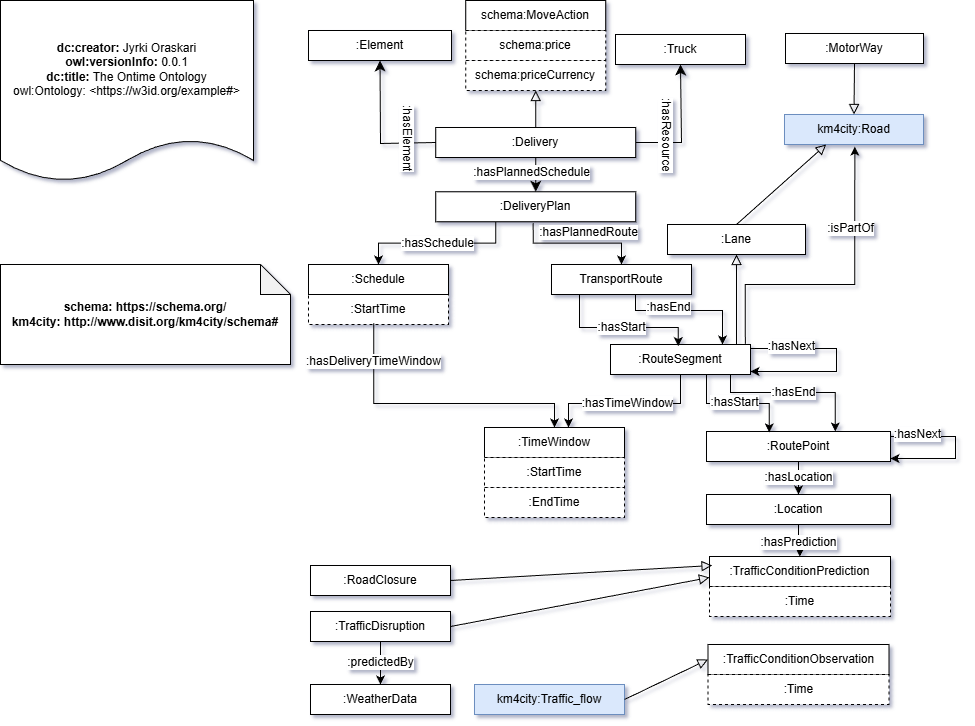
Cross-reference for The Ontime Ontology classes, object properties and data properties back to ToC
This section provides details for each class and property defined by The Ontime Ontology.Classes
- Delivery
- Delivery Plan
- Element
- Lane
- Location
- Motor Way
- Move Action
- Road
- Road Closure
- Route Point
- Route Segment
- Schedule
- Time Window
- Traffic Condition Observation
- Traffic Condition Prediction
- Traffic Disruption
- Traffic_flow
- Transport Route
- Truck
- Weather Data
Deliveryc back to ToC or Class ToC
IRI: https://w3id.org/ontime#Delivery
- has super-classes
- Move Action c
- is in domain of
- has element op, has planned schedule op, has resource op
Delivery Planc back to ToC or Class ToC
IRI: https://w3id.org/ontime#DeliveryPlan
- is in domain of
- has planned route op, has schedule op
- is in range of
- has planned schedule op
Elementc back to ToC or Class ToC
IRI: https://w3id.org/ontime#Element
- is in range of
- has element op
Lanec back to ToC or Class ToC
IRI: https://w3id.org/ontime#Lane
- has super-classes
- Road c
- has sub-classes
- Route Segment c
Locationc back to ToC or Class ToC
IRI: https://w3id.org/ontime#Location
- is in domain of
- has prediction op
- is in range of
- has location op
Roadc back to ToC or Class ToC
IRI: http://www.disit.org/km4city/schema#Road
- has sub-classes
- Lane c, Motor Way c
- is in range of
- is part of op
Road Closurec back to ToC or Class ToC
IRI: https://w3id.org/ontime#RoadClosure
- has super-classes
- Traffic Condition Prediction c
Route Pointc back to ToC or Class ToC
IRI: https://w3id.org/ontime#RoutePoint
- is in domain of
- has location op, has next op
- is in range of
- has end op, has next op, has start op
Route Segmentc back to ToC or Class ToC
IRI: https://w3id.org/ontime#RouteSegment
- has super-classes
- Lane c
- is in domain of
- has end op, has next op, has start op, has time window op, is part of op
- is in range of
- has end op, has next op, has start op
Schedulec back to ToC or Class ToC
IRI: https://w3id.org/ontime#Schedule
- is in domain of
- has delivery time window op
- is in range of
- has schedule op
Time Windowc back to ToC or Class ToC
IRI: https://w3id.org/ontime#TimeWindow
- is in range of
- has delivery time window op, has time window op
Traffic Condition Observationc back to ToC or Class ToC
IRI: https://w3id.org/ontime#TrafficConditionObservation
- has sub-classes
- Traffic_flow c
Traffic Condition Predictionc back to ToC or Class ToC
IRI: https://w3id.org/ontime#TrafficConditionPrediction
- has sub-classes
- Road Closure c, Traffic Disruption c
- is in range of
- has prediction op
Traffic Disruptionc back to ToC or Class ToC
IRI: https://w3id.org/ontime#TrafficDisruption
- has super-classes
- Traffic Condition Prediction c
- is in domain of
- predicted by op
Traffic_flowc back to ToC or Class ToC
IRI: http://www.disit.org/km4city/schema#Traffic_flow
- has super-classes
- Traffic Condition Observation c
Transport Routec back to ToC or Class ToC
IRI: https://w3id.org/ontime#TransportRoute
- is in domain of
- has end op, has start op
- is in range of
- has planned route op
Weather Datac back to ToC or Class ToC
IRI: https://w3id.org/ontime#WeatherData
- is in range of
- predicted by op
Object Properties
- has delivery time window
- has element
- has end
- has location
- has next
- has planned route
- has planned schedule
- has prediction
- has resource
- has schedule
- has start
- has time window
- is part of
- predicted by
has delivery time windowop back to ToC or Object Property ToC
IRI: https://w3id.org/ontime#hasDeliveryTimeWindow
- has domain
- Schedule c
- has range
- Time Window c
has elementop back to ToC or Object Property ToC
IRI: https://w3id.org/ontime#hasElement
has endop back to ToC or Object Property ToC
IRI: https://w3id.org/ontime#hasEnd
- has domain
- Route Segment c
- Transport Route c
- has range
- Route Point c
- Route Segment c
has locationop back to ToC or Object Property ToC
IRI: https://w3id.org/ontime#hasLocation
- has domain
- Route Point c
- has range
- Location c
has nextop back to ToC or Object Property ToC
IRI: https://w3id.org/ontime#hasNext
- has domain
- Route Point c
- Route Segment c
- has range
- Route Point c
- Route Segment c
has planned routeop back to ToC or Object Property ToC
IRI: https://w3id.org/ontime#hasPlannedRoute
- has domain
- Delivery Plan c
- has range
- Transport Route c
has planned scheduleop back to ToC or Object Property ToC
IRI: https://w3id.org/ontime#hasPlannedSchedule
- has domain
- Delivery c
- has range
- Delivery Plan c
has predictionop back to ToC or Object Property ToC
IRI: https://w3id.org/ontime#hasPrediction
- has domain
- Location c
- has range
- Traffic Condition Prediction c
has resourceop back to ToC or Object Property ToC
IRI: https://w3id.org/ontime#hasResource
has scheduleop back to ToC or Object Property ToC
IRI: https://w3id.org/ontime#hasSchedule
- has domain
- Delivery Plan c
- has range
- Schedule c
has startop back to ToC or Object Property ToC
IRI: https://w3id.org/ontime#hasStart
- has domain
- Route Segment c
- Transport Route c
- has range
- Route Point c
- Route Segment c
has time windowop back to ToC or Object Property ToC
IRI: https://w3id.org/ontime#hasTimeWindow
- has domain
- Route Segment c
- has range
- Time Window c
is part ofop back to ToC or Object Property ToC
IRI: https://w3id.org/ontime#isPartOf
- has domain
- Route Segment c
- has range
- Road c
predicted byop back to ToC or Object Property ToC
IRI: https://w3id.org/ontime#predictedBy
- has domain
- Traffic Disruption c
- has range
- Weather Data c
Data Properties
end timedp back to ToC or Data Property ToC
IRI: https://w3id.org/ontime#EndTime
pricedp back to ToC or Data Property ToC
IRI: https://schema.org/price
price currencydp back to ToC or Data Property ToC
IRI: https://schema.org/priceCurrency
start timedp back to ToC or Data Property ToC
IRI: https://w3id.org/ontime#StartTime
timedp back to ToC or Data Property ToC
IRI: https://w3id.org/ontime#Time
Legend back to ToC
op: Object Properties
dp: Data Properties
References back to ToC
Add your references here. It is recommended to have them as a list.Acknowledgments back to ToC
The authors would like to thank Silvio Peroni for developing LODE, a Live OWL Documentation Environment, which is used for representing the Cross Referencing Section of this document and Daniel Garijo for developing Widoco, the program used to create the template used in this documentation.